
Anatomy lab
On cutting someone open

Hi all,
Happy New Year. I hope your year has begun with hope, warmth, and the company of people you love. New Years might be my favorite holiday. I love any excuse to look backwards and forwards and begin again. I’ve decided the words of the year are “Togetherness”, “Courage”, “Simplicity,” and “Beingness”.
I spent New Years in Boston, circling the most holy reservoir I used to live by and attending mass at my favorite church in the world. I shared wine with my childhood, now-adult best friend and we discussed the ins and outs of the year. Notably, quality time and budgeting is in, while influencer podcast culture and meal prep is out. I listened to beautiful music, closed my eyes in the passenger seat of a car and felt a specific peace I don’t think I’ve known before; a peace I truly believe will come to define this next part of my life.

Back in DC, there is also peace, and joy, and community beyond my greatest expectation, but this month was the first time since being in medical school that I seriously thought, “Maybe I don’t want to do this.”
One week ago, we started working with cadavers. I knew anatomy lab would be a part of our spring curriculum and never thought twice about it until two days before our first lab session.
I was sitting in a lecture on the anatomy of the thorax, following along unaffected while the professor flicked through pictures of anatomical structures. Very normal. The graphics shifted to pictures of dissected lungs and a ribcage. I swear I’ve never seen a ribcage like that in my life. It didn’t hit me until that point that this raw, living-dead tissue would be our work of “anatomy lab” and I cried for a bit, right there in the lecture hall.
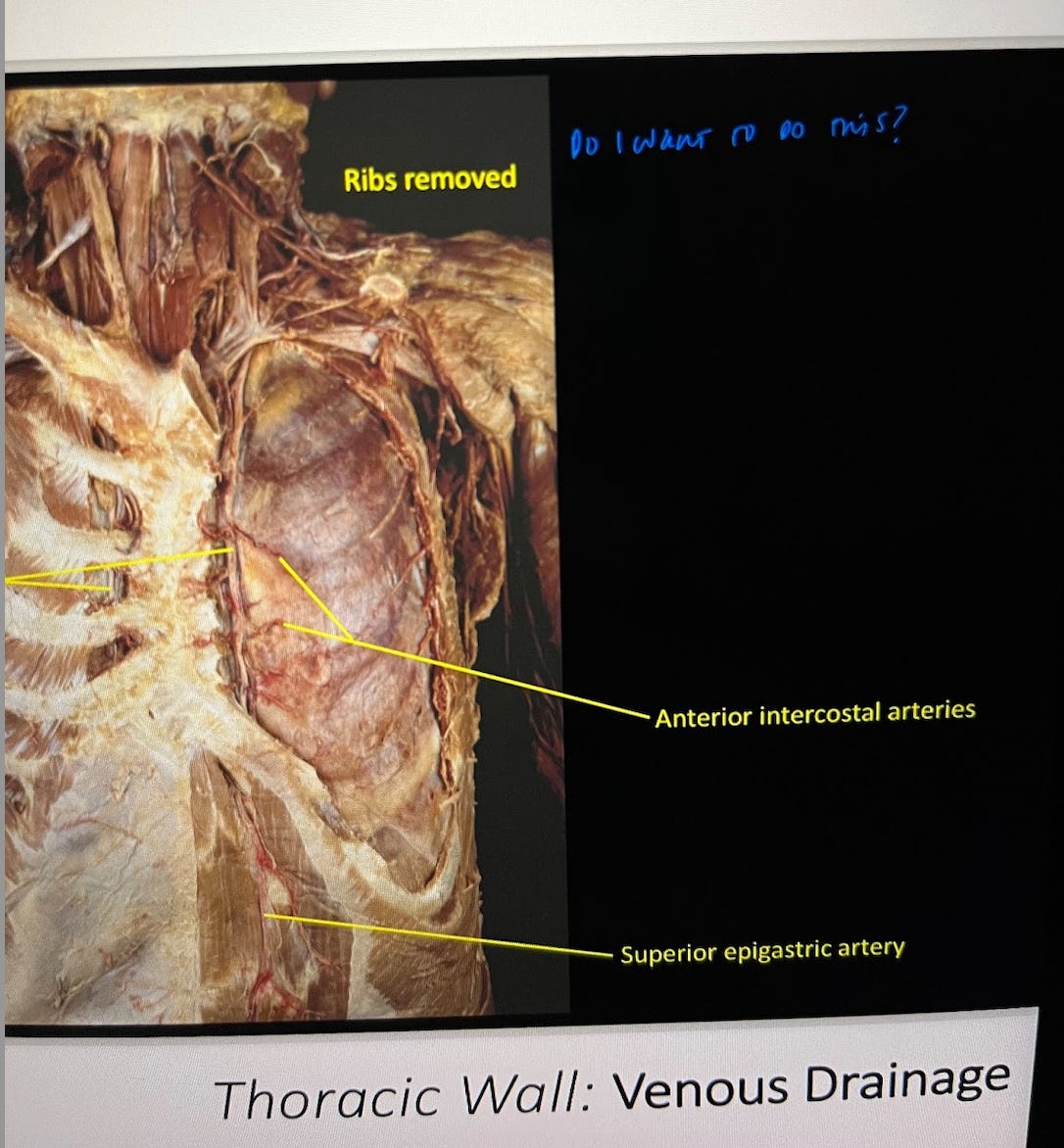
The days following lecture and leading up to lab, I couldn’t stop thinking about that dissected ribcage. I shared my anxieties with everyone that would listen, hoping for solace in mutually shared distress. While watching the assigned pre-lab dissection videos, I literally covered my eyes and sobbed. The recorded demonstration on how to break clavicles and remove the cadaver’s ribcage felt like actual murder. How could we be so cruel as to destroy proof of someone’s life? What does it mean to hold a knife to an unblemished chest; to take up a bone saw and slice through the ribs that once shrouded living breath? Who am I to approach the Spirit’s temple with a scalpel and forceps?
People love to say: “The donors knew exactly what they were signing up for. They wanted you to do this.” The desire to have one’s body “donated to science” does not justify the mechanical terror that follows donation. I can’t decide if the expectation to dissect a human person, and the responsibility we have to their body, is the most terrible or sacred part of medical education.
Our first lab session began with an interfaith blessing from the school’s chaplain priest, rabbi and imam. There was a shared somberness in my group that I found comforting. We huddled around our body bag, stenched with formaldehyde and heavy with the distinct presence of a preserved human being. I thought I would be sick from the feeling that I was about to kill someone.
A moment later, our group took turns unzipping the portion of the bag proximate to us, gradually revealing the entirety of a female with her head wrapped in cellophane and hands tied in hemp rope. I turned around and shut my eyes. In front of us was her, our donor, revealing the truth of her body. We kept still for a few moments and one of my group members placed his hand on her arm, as if to soothe her.
“Intimacy unhinged, unpaddocked me. I didn’t want it.
Believe me, I didn’t want it anymore. Who in their
right mind?…”
[Intimacy unhinged, unpaddocked me] - Dianne Seuss
I cried again, forcing myself to look at our beautiful, dead donor. I prayed to both her and God to conjure the most good out of this dissection as possible. Eventually, a lab partner handed me the scalpel and I cut through the outline of her right thoracic cavity. In that act, I felt our donor’s body to be my own. Our shared humanity was revealed through her total kenosis of flesh. This would be her first lesson to us in what it means to be both dead and alive.
After three hours of sinking our hands into a pool of fascia and adipose tissue, we were given a five-minute warning and asked to pull out our phones to take an online quiz. Just like that, the lab now dark and illuminated only by a projected computer screen, we were expected to forget the severed body in front of us. Now this was ridiculous – I took one step back to ensure I wouldn’t drop my phone into our donor’s open chest. The reverence of our scientific undoing was thwarted by the false urgency of an ungraded quiz. And then we were done.
We disinfected the body bag with bleach, removed our aprons and left the room locked. I walked home and uncovered my own body to wash away the lingering formaldehyde. From hers, to mine. Flesh to flesh.
And this was just the first lab session. Moving towards our next lab, a lot of my hesitancies have been quelled by the gentle and intentional manner of my group members. I feel incredibly blessed to have them to journey with, and moreso, to have our donor. The gift of her petrified body is yet to reveal the bulk of her truths; I pray that we may receive each of her mysteries with an increasing sense of appreciation and awe.
Thank you for being here, for bearing my drama with grace, and for having a body of our own.
Many blessings in the new year.
Abby
P.S. – The most helpful words given in response to my lab anxieties came from our lab TA. He said that by the end of the year, after dissecting his donor’s entire body, bone by organ by nerve, he felt as though he knew her better than anyone in the world. Better than all the doctors that cared for her throughout her health and illness. He said, “I don’t know how you feel about the afterlife, but I believe she’s in a better place.”
Just thought I’d share, in case it’s helpful for you too.